FREE SHIPPING!
Due to high demand, capsule orders may take 1-2 days to process!
SAME DAY SHIPPING (up to 2pm CST)
New customers save 10% off with code WELCOME10
Due to high demand, capsule orders may take 1-2 days before shipment
All orders ship free (orders $20 or more get upgraded to USPS priority Mail)
Where Does Kava Come From? Origins & History Explained by MitraMan
Where Does Kava Come From Origins & History Explained by MitraManKava originates in the South Pacific and has been cultivated there for thousands of years. It is made from the roots and basal stem (rhizome) of the Piper methysticum plant. Across Pacific Island societies, Kava has long played a central role in ceremonies, leadership discussions, and community gatherings.In this blog, we’ll cover:
Where does Kava come from, and which plant does it derive from
The Pacific Island regions where it originated
How it became part of daily and ceremonial life
How it was traditionally prepared and shared
How it spread beyond the islands into modern drinks
Where Does Kava Come From? Understanding Its Origin
Kava is derived from the plant Piper methysticum, a cultivated member of the pepper family. Unlike many herbs that grow from seeds, Kava is propagated from stem cuttings, meaning every plant is genetically linked to its parent.Only the root and basal stem (rhizome) are used in traditional preparations because they contain Kavalactones, the naturally occurring compounds associated with Kava’s characteristics. The leaves and upper stems are not used for drinking preparations.This distinguishes Kava from botanicals like kratom, which are made primarily from dried leaves rather than root material.
Which Countries Is Kava Native To?
While its botanical identity explains what Kava is, its geographic origin explains where its traditions developed. Here are the main countries where Kava originates:
Vanuatu – Often seen as the birthplace of Kava
Fiji – One of the most well-known Kava-growing regions
Samoa – Kava has long been part of social and cultural customs
Tonga – Commonly shared during ceremonies and community events
Hawaii – One of the few places outside Melanesia with native Kava traditions
Papua New Guinea – Part of the broader Melanesian region
Federated States of Micronesia – Including islands like Pohnpei and Kosrae
The Cultural History of Kava
Long before international trade introduced Kava to global markets, it held deep ceremonial meaning in Pacific societies. It was not treated as a casual beverage. It was prepared with intention and shared during moments of leadership, reconciliation, alliance-building, and community decision-making.Ceremonies followed structured customs. The preparation process, serving order, and presentation reflected hierarchy and respect. In many regions, Kava symbolized unity, diplomacy, and social harmony.Although customs vary between islands, the cultural significance remains consistent: Kava represents connection, tradition, and shared identity.
How Did Kava Spread Beyond the Pacific Islands?
Kava’s movement beyond the Pacific was gradual rather than sudden.
20th-Century Commercial Trade: As maritime trade expanded, dried Kava root began entering international markets.
German Research (1990s): Clinical studies in Germany examined standardized Kava extracts, introducing it to European herbal markets.
European Regulatory Restrictions (Early 2000s): Several EU countries restricted Kava products due to liver safety concerns linked to certain extract preparations. Some of these restrictions were later revised or lifted.
United States Advisory Period: In the U.S., Kava was never federally banned but was subject to safety advisories. It remains legally available, with regulations varying by state.
Where Does Kava Come From? A Look at Cultivation and Classification
When asking where Kava comes from, the answer goes beyond location. It also involves how the plant is cultivated and how different varieties are classified.
Cultivation Practices
Kava comes from the plant Piper methysticum, which is cultivated rather than wild-harvested.
The plant is propagated from stem cuttings, meaning new plants are genetically linked to the parent plant.
Farmers selectively grow specific cultivars that have been developed over generations.
Only the root and basal stem (rhizome) are harvested for preparation, as these contain Kavalactones.
Because it does not reproduce effectively by seed, Kava depends on careful human cultivation to survive and spread.
Classification and Varieties
Over time, Pacific Island farmers developed distinct cultivars with unique characteristics.
Kava is commonly classified into “noble” and “tudei” types based on traditional standards.
These classifications relate to plant genetics and chemical composition.
Regional growing conditions, including soil and climate, can influence overall Kavalactone ratios.
Understanding where Kava comes from in terms of cultivation and classification helps explain why product labels reference origin, cultivar type, and processing method.Read More: Noble vs Tudei Kava
How Kava Has Been Traditionally Prepared
In traditional Kava culture,making Kava was a hands-on and shared process. Preparation usually took place before gatherings or ceremonies. Each person knew their role and followed the methods to prepare the drink.
Harvesting and cleaning – Fully grown Kava roots were carefully harvested and washed to remove soil and debris.
Breaking down the root – The roots were crushed into a fibrous pulp, either by chewing or by pounding them using stones or a mortar and pestle.
Mixing with water – The pulp was blended with cool or lukewarm water to draw out the compounds from the root.
Straining the mixture – Natural filters like coconut fiber, bark, or cloth were used to separate the liquid from the solids.
Kneading and squeezing – The mixture was worked by hand until the liquid became cloudy and thick.
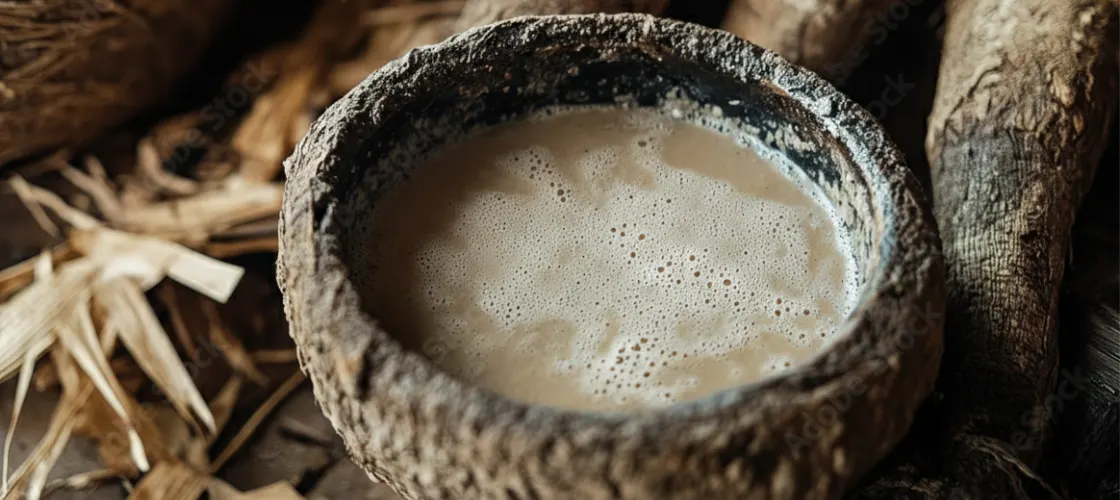
Serving and sharing – The freshly prepared drink was shared right away, often from a coconut shell, as part of a group gathering or ceremony.
Kava Today – From Traditional Roots to Modern Drinks
Kava has evolved from a ceremonial drink shared in Pacific Island communities to a globally distributed botanical product. While traditional preparation methods remain important, modern processing and packaging have expanded how Kava is offered and consumed today.
Common Modern Formats
Instant Kava Powders: Finely processed for direct mixing without straining, designed for convenience and faster preparation.Ready-to-Mix Drinks: Pre-formulated blends intended for simplified preparation at home or in social settings.Kava Mocktails: Alcohol-free beverages incorporating Kava into contemporary drink menus.Read More: Is Kava Good for You?
Final Thoughts: Understanding Where Kava Comes From
Kava’s story begins in the agricultural and ceremonial traditions of the South Pacific and continues today in modern markets around the world. From its cultivation as Piper methysticum to its role in community gatherings, the plant carries both cultural and botanical significance.Understanding where Kava comes from provides context about how it is grown, classified, and prepared. Its origin influences not only tradition but also how modern products are labeled, processed, and evaluated.Whether encountered in its traditional preparation or contemporary formats, Kava remains connected to centuries of cultivation and cultural practice.
FAQs
1. Where does Kava come from originally?
Kava comes from the South Pacific islands. Its earliest origins are traced to places like Vanuatu, where it has been cultivated for thousands of years.
2. What country produces the best Kava?
Vanuatu is widely regarded as producing some of the highest-quality Kava. This reputation comes from its long cultivation history and well-established traditional varieties.
3. Is Kava native to Hawaii?
Kava is not originally native to Hawaii. It was brought to the islands centuries ago. Since then, it has become part of Hawaiian cultural practices and is grown for ceremonies and social gatherings.
4. Why is Kava important in Pacific Island culture?
Kava plays a central role in ceremonies and social gatherings. It brings communities together and marks important occasions.
5. Is Kava a root?
Kava comes from both the root and the basal stem, called the rhizome. That’s why many people just say “Kava root.”
6. Why does origin matter for modern buyers?
Where Kava is grown affects its chemical profile. Soil and climate influence Kavalactone levels. Labels like “Vanuatu noble” help buyers identify high-quality Kava.
7. Is all Kava grown today genetically similar?
No. Kava has different cultivars. Noble vs. tudei classifications show differences in potency and safety. Names can also vary across regions.
8. How did Kava reach Micronesia and Polynesia?
It spread through human migration. The Lapita expansion and canoe travel carried Kava to new islands. Communities took it with them and kept cultural practices alive.
9. Why doesn’t Kava grow wild everywhere in the Pacific?
Kava needs human care to grow. It doesn’t spread easily on its own. Farmers propagate it from cuttings, not seeds.